


The moment your content sounds like an LLM output, you aren’t just losing engagement—you are failing the Anti-Bullshit Filter. You are training your own replacement.
It starts with a quiet, sinking feeling. You reread a draft and realise it’s too smooth. Too polite. It has that unmistakable, synthetic cadence of a chatbot trying to be helpful. You’ve spent weeks absorbing generic “creator advice,” and now your natural voice is gone. It has been overwritten by a sanitised, interchangeable slurry.
In a world where machines generate “correct” text in seconds, sounding “correct” is no longer a metric for success. It is the baseline for being ignored. This is the Sameness Trap. It allows you to feel productive while hitting “Publish” on a tutorial written a thousand times before.
But the reality for a developer in 2026 is brutal. If your work cannot be distinguished from a prompt response, your career is no longer resilient. You are fighting entropy. To win, you must stop treating writing as a creative hobby. You must treat it as an engineering discipline with strict quality gates.
Installing an Anti-Bullshit Filter stops you from being a faceless node in the machine. Your work gains the weight of authority because it is anchored in lived friction—the bugs that broke your spirit and the trade-offs that kept you up at 2:00 AM.
It is harder. It forces you to delete 60% of what you write because it’s “polite noise.” But that discomfort is the signal. It is the difference between “posting content” and “building an asset.” You have a choice: continue reinforcing your own replaceability, or install the filter and refuse to ship low-value content ever again.
From Code-Closer to IP Architect

By now, the pattern is clear enough to make you uncomfortable. Sameness creeps in the moment you stop inspecting your thinking. But a deeper failure mode sits underneath: you still treat publishing as “expression” instead of extraction.
You write after the work is done, rather than from the work. Every post starts from zero—new energy, new risk, and a high chance of drifting back into polite, AI-shaped commentary. The real shift isn’t about learning to write better. It is about realising you aren’t just closing tickets anymore. You are building Intellectual Property assets in the public domain.
When you adopt this frame, the “consistency” trap collapses. Momentum without meaning is just noise. An extraction-based identity provides leverage. You stop inventing ideas and start harvesting them. You stop chasing “freshness” and start building clarity.
The trade-off? Weak ideas become expensive. When you treat content as IP, you can’t afford to be vague. That pressure is exactly what raises your signal. It is the difference between being a labourer who clears a queue and an architect who builds a library.
The New “Definition of Done”
A task isn’t finished when the code works. It is finished when the insight is extracted. Every closed ticket or debated architectural decision should produce a “fragment.”
Capture the context, the trade-off, and the hard decision made. These aren’t scattered notes. They are the inventory you draw from when you sit down to publish. This eliminates blank-page paralysis entirely. You are no longer staring at a void; you are selecting from a proven inventory of lived friction.
Unnamed insight leaks. Structured insight compounds.
Identity Anchor: > Transitioning from “ticket-closer” to “IP Architect” is a mental shift that requires a physical trigger. The Monolith v1.0 Shirt isn’t just apparel; it’s a uniform for the developer who refuses to be a faceless node in the machine. When you put it on, you aren’t just coding—you’re building a legacy.
The Cost of Being “Safe”: Why Your Content Fails
That familiar sting is hard to ignore. After sitting there for hours tightening every line and sanding down every rough edge, the piece finally reads “clean.” But hitting publish with the hope that this is the one usually results in the same thing: total silence from the internet.
That is the pain we don’t talk about: the fear that you’ve become invisible.
Deep down, you know how you got here. You walked straight into the Sameness Trap. You believed that sounding “professional,” neutral, and polished would keep you safe. Instead, you produced a neatly formatted explainer that an LLM can spit out in three seconds flat.
The Cost of Neutrality
When your content reads like an LLM output, you aren’t just losing engagement. You are training your own replacement. Each interchangeable paragraph tells the reader that you are interchangeable, too. Once your voice dissolves into the algorithmic slurry, no amount of effort will pull it back out.
Writing for humans is your only defensible advantage. Technical tutorials can be automated. Documentation can be summarised. But the insight you earned the hard way? The tension of the trade-offs you lived through? That is beyond automation.
Protect the “Human Mess”
Writing for humans requires confronting your own experience. You must drop the “professional” mask. Start with the last mistake that actually cost you something—the bug that humiliated you or the shortcut that backfired.
Strip the narrative down until one sharp truth remains. Then ask: “Could AI generate this?” If the answer is yes, delete it.
Beginners skip this to sound “correct.” Growth-stage creators sprint past it to chase volume. But if you want content that compounds, the “human mess” is the only layer worth protecting. High-signal content shouldn’t feel tidy. If the insight doesn’t scare you a little, it won’t move anyone else.
Identity Anchor: Choosing the “human mess” over the “professional mask” is a high-stakes decision. TheMonolith v1.0is designed for this exact mindset. It’s the uniform for the developer who refuses to be a ghost in the machine.
The System Check: What “Anti-Bullshit” Actually Means
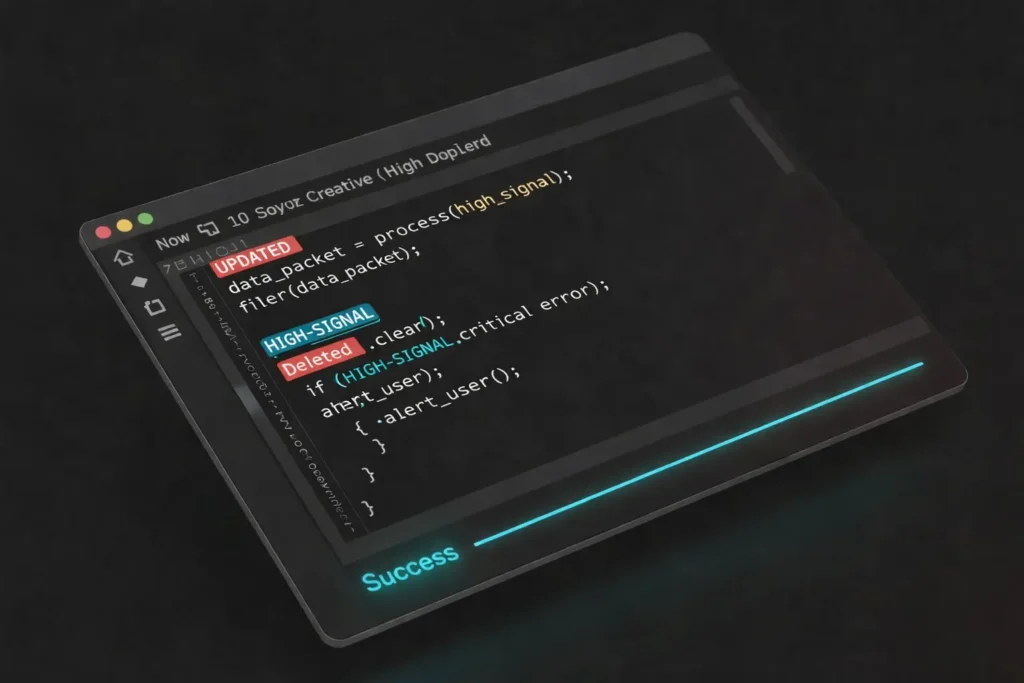
“Anti-Bullshit” isn’t a personality trait. It is a calculated commitment to your Signal-to-Noise Ratio.
As an engineer, you wouldn’t dream of shipping bloated, broken code. Yet, most developers spend their “creator time” shipping paragraphs that pass visual inspection but collapse under the slightest intellectual load. This is the breaking point. You must stop treating writing as an emotional outlet and start treating it as a Unit Test for your ideas.
If sameness is the villain, noise is the mechanism. Noise makes your paragraphs sound “fine” while saying absolutely nothing. Once you see it, you can’t go back. Your drafts are either high-signal or they are broken.
Writing as a Unit Test
Building your content like a system ensures your ideas stop leaking value. When you treat paragraphs like modular components, you stop relying on a “nice tone” to carry a weak argument.
The implementation is mechanical. Inspect your sentences with the same skepticism you reserve for legacy code. Look for where the logic bends. Look for hidden assumptions. Strip the paragraph down to the raw data of your experience, then reintegrate it—cleaner, tighter, and undeniably yours. This isn’t about being a “better writer.” It’s about being a more honest architect.
Specificity: The Only Cure for Noise
Every creator’s noise stems from a different insecurity:
- Beginners: Drown in noise because they haven’t learned to question their own claims. The fix: Radical focus on one example and one transformation.
- Growth-Stage: Struggle with self-deception. You know a paragraph is weak, but you publish it anyway to maintain the “feeling” of consistency.
- Monetizers: Noise is existential. Every vague sentence dilutes the economic scarcity of your expertise.
The universal truth? Specificity is the cure. Your sharpest tool is the moment the algorithm could never infer because it didn’t live it.
Deleting Your Ego
Cutting 30% of a draft feels like deleting a part of yourself. It isn’t. You are deleting your ego. Running a unit test on your ideas forces you to confront where you’ve been lazy or performative.
That pain is productive. It is the cost of graduating from someone who “posts” to someone who “publishes.” Highlight every sentence that echoes a generic “top 10” list. Delete them. What remains is your signal.
Identity Anchor: > Enforcing this filter gives you something better than professionalism: it gives you authority. The Market Fit Git Graph Tee represents this iterative, high-signal grind. It’s for the creator who understands that “Market Fit” only happens when you stop shipping noise.
Filter 1: The Mandatory Inputs (Killing the “Desire Trap”)
By now, you’ve felt the weight of sameness. You’ve realized your drafts collapse the moment you stop inspecting them. But a deeper pattern keeps growth-stage developers spinning in circles: you start writing because an idea feels “exciting,” not because it solves a human problem.
This is the Desire Trap. It tricks you with momentum. It convinces you that “feeling inspired” is the same as having clarity. When you chase the buzz instead of the reader, your paragraphs drift into that polite, flavorless tone you’re trying to escape.
Abstraction is the natural resting state of lazy thinking. It is where high-signal work goes to die.
Solving for One Person
Filter 1 forces writing to move from self-expression to service. The test is deceptively simple: Does this solve a specific pain for a specific person? Growth-stage creators are the most vulnerable here because you know enough to fake value. To pass this gate, you must articulate the scene in one line: “Sam is drowning in half-built tools and doesn’t know which workflow to trust.” That snapshot locks the piece onto a human reality. Suddenly, every sentence has a boundary.
The Cost of Enthusiasm
High-signal writing isn’t built from enthusiasm; it’s built from specificity. The cost of this filter is that you will have to abandon 70% of the ideas that felt “exciting” but weren’t actually useful.
That friction is the point. If you want to stop your ideas from dissolving into abstraction, you have to define your “Signal Zone.” You wouldn’t debug a complex system in a chaotic environment; you shouldn’t architect IP there either.
Identity Anchor: Passing this first gate is the moment the system goes from “Idle” to “Active.” The Success Instance Initialized Shirt is the anchor for this stage. It’s a physical reminder that your work has officially started because you’ve moved past the “Desire Trap.”
Filter 2: The Moat Test (Engineering a Defensible Perspective)
Most developers don’t publish because their ideas aren’t original. They reread a draft and realize: Anyone could have written this.
That moment is supposed to hurt. Your brain is firing a high-priority alarm. It knows you’re writing from surface-level consensus, not lived expertise. In 2026, safety is indistinguishable from invisibility.
If an expert wouldn’t disagree with your point, you haven’t written an insight. You’ve written a platitude.
Build a Spine, Not a Platitude
This is the Moat Test. It separates generic content from a defensible perspective. To escape this loop, you must attack consensus:
- Name the “best practice” you find overrated.
- Share the trade-off you learned when a popular framework failed you at scale.
These moments of friction are your moat. It is the defensible edge that only comes from being in the room when things broke.
The Expert Challenge
Before you ship, ask: What, exactly, would an expert challenge here? If the answer is “nothing,” you haven’t dug deep enough. Set a timer for ten minutes. Rewrite your core idea through the lens of friction. Find the contradiction, the hidden cost, or the bold claim you are willing to stand behind.
Stop writing like a diplomat. Start writing like someone with a spine.
Filter 3: The Architecture Check (Turning Fog into Systems)
Every creator eventually hits the wall where an idea sounds brilliant in their head but collapses the moment they try to teach it. That gap isn’t a flaw in your writing. It’s a flaw in your thinking.
This filter exists to expose whether your insight is a defensible system or just a sentence. If you can’t draw it, sequence it, or name it, you don’t have an insight yet—you just have energy disguised as clarity.
Dragging Ideas Into the Real World
Filter 3 forces you to convert mental fog into functional scaffolding. Break any vague concept into three mechanical steps:
- Assign each step a specific purpose.
- Define the constraint and failure mode.
- Name the whole thing.
Systems remove the hiding places. They force you to decide which parts of your workflow you’ve been bullshitting yourself about.
Sequence the Moves
The practical side is light: you need ten quiet minutes and a pen. List the actual physical moves you take when an idea works in your life, then sequence them.
- Beginners: Structure kills the overwhelm of the blank page.
- Growth-Stage: Structure provides the intellectual architecture you can reuse across platforms.
- Monetizers: A named framework is the seed of a product.
AI can summarize text, but it cannot originate architecture built from human trade-offs.
Identity Anchor: Building a system is an iterative process. TheMarket Fit Git Graph Teeis for the creator who treats their ideas like code—constantly merging, refactoring, and shipping better versions.
Execution: The 5-Minute Pre-Flight Routine
Execution is non-negotiable. The 5-Minute Pre-Flight Routine is the mechanical gate you run before you write a single sentence.
The 6-Point Deployment Protocol
Filling all six boxes ensures your draft has a defensible spine. Conversely, leaving even one empty means you are about to produce interchangeable content. Unless you can answer these six points in a single, concrete line, you don’t have a draft—you have fog:
- The Target: Name the specific person and their obstacle.
- The Truth: State your blunt, disagreeable claim.
- The Framework: Map the A → B → C steps.
- The Evidence: Cite one failure, scar, or hard stat.
- The Hype Audit: Identify and delete one AI-sounding “filler” phrase.
- The Outcome: Define exactly what the reader does next.
If all six boxes are filled, your draft has a defensible spine. If even one is empty, you are about to produce interchangeable content.
Stop Avoiding the Truth
If you say you “don’t have time” for this five-minute gate, you are lying to yourself. You aren’t lacking time; you’re avoiding the moment where your idea proves it doesn’t deserve to exist.
Never skip the Evidence line. Write fragments, not paragraphs. This is engineering, not journaling. Run the routine. Then write. No excuses.
In the End: The Choice to Stop Guessing
You are back at the cursor. You can keep “guessing”—polishing drafts, trusting vibes, and hoping the algorithm validates your existence. Or, you can take ownership of your signal.
Guessing feels lighter because it avoids commitment. Engineering does the opposite by forcing strict constraints. By deciding what actually matters before you write, you eliminate the “vibe-based” drift. This shift represents the exact moment you replace hope with structure.
The Quiet Erosion of Authority
The consequence of avoiding this shift is subtle but brutal. When you guess, nothing explodes. You simply train your audience not to expect much from you.
Each “fine” post teaches them that your ideas blend in. Engineering your content reverses that trajectory. You might publish less, but you publish with intent. Your work develops edges. Every draft you ship either sharpens your identity or dulls it. There is no neutral outcome.
The Commitment
Refuse to be interchangeable. Your thinking is worth more than another recycled tutorial. You are becoming a developer who publishes with intent, leverage, and identity—not noise.
If you are ready to stop wandering and start building, grab the exact execution gate—the six questions that decide whether a draft lives or dies.
![The Developer’s Anti-Bullshit Filter The 6-Point Check That Guarantees High-Signal Content [DOWNLOAD THE ANTI-BULLSHIT FILTER CHECKLIST]](https://digitalcreatorworld.com/wp-content/uploads/2026/01/The-Developers-Anti-Bullshit-Filter-The-6-Point-Check-That-Guarantees-High-Signal-Content-DOWNLOAD-THE-ANTI-BULLSHIT-FILTER-CHECKLIST-1024x576.webp)
[DOWNLOAD THE ANTI-BULLSHIT FILTER CHECKLIST]
High-signal thinking requires a high-signal environment. If you’re ready to stop being a “faceless node” and start building your legacy, explore the Digital Creator World Shop. From the Monolith v1.0 to the Success Instance apparel, this is gear built for developers who treat their IP as an engineering discipline.