
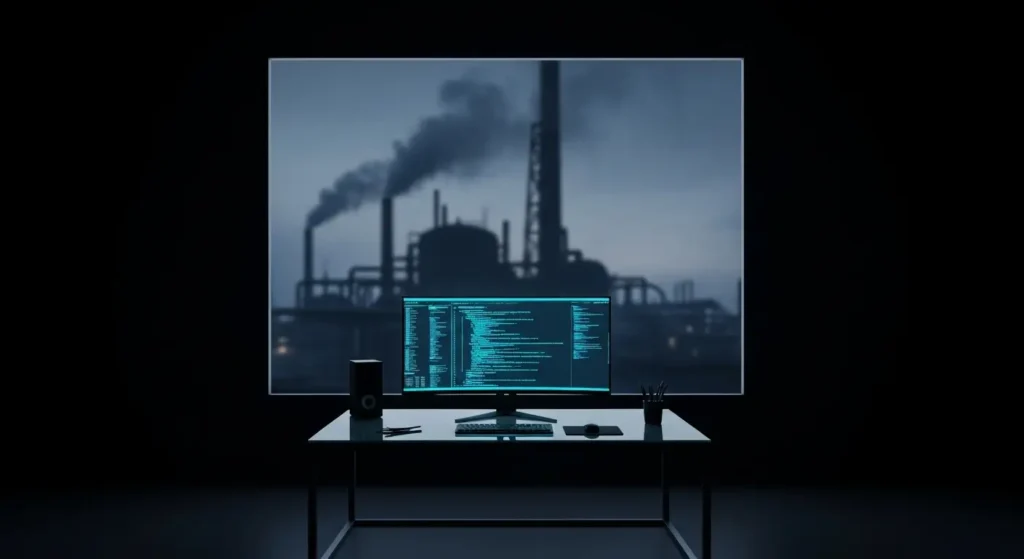
It is 3:30 a.m. in England. The radiators are clicking, the house is silent, and the coffee hasn’t kicked in. For most, this is the middle of the night. For me, it is the only window of time I actually own.
By 5:00 a.m., I will be cycling 3.7 miles through the rain to operate a million-pound industrial foiling machine. It is a masterpiece of engineering, but it is not mine. I am merely a node in someone else’s system. If I stop showing up, the machine keeps running. I am a depreciating asset in their warehouse.
Many developers are living this same “Short Position.” You write clean code. Solve complex bugs. You build elegant systems. But because that work stays buried in a private repo or a company Jira ticket, you are invisible. You are renting your pulse to a machine you don’t own.
In a world where AI can generate boilerplate in seconds, “just being a coder” is a liability. To survive, you must refactor your invisible labor into Digital Equity. You must stop building “portfolios” and start building a public “Thinking Engine.”
Protocol 01: Refactor Output into Decision Logic
Most developer portfolios are graveyards of dead projects—neat grids of “Todo Apps” whispering, “Look what I built.” This is a low-signal strategy. Nobody has the time to read your source code to guess if you are actually useful.
A high-signal showcase is a Case Study. It shifts the focus from the output to the architecture. It proves you can identify system entropy and engineer a way out of it.
When you showcase a project, stop showing the finished walls. Show the blueprints. Why did you choose React over Vue for this specific edge case? What was the latency bottleneck that broke the system at 2:00 a.m., and how did you refactor the logic to fix it? You aren’t selling “Code.” You are selling the Systematic Removal of Friction.
Protocol 02: The 90-Second Signal (Zero Latency)
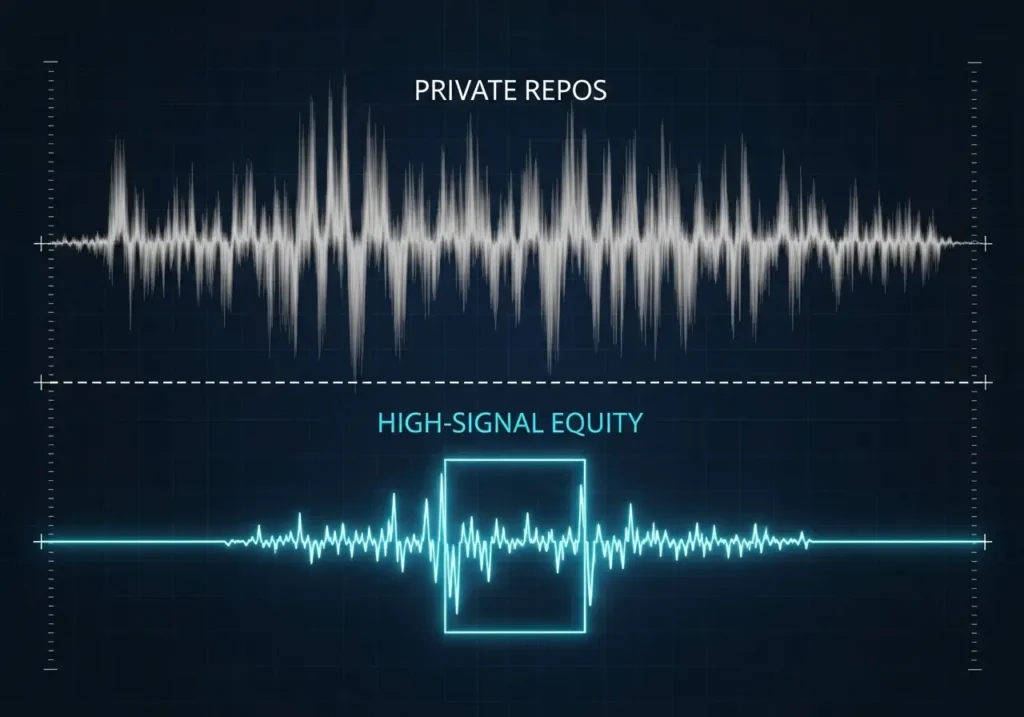
The gap between your work and the viewer’s eyes is “Latency.” If a recruiter or collaborator has to npm install your dependencies or debug a missing .env file just to see your app, you have already lost.
The Gietz machine I operate is complex, but its output is immediate. You see the foil hit the paper, and you know it works. Your code needs that same industrial signal.
Every project you showcase must have a 90-Second Signal Demo. Record a raw walkthrough.
- 00-15s: State the specific frustration this code solves.
- 15-60s: Show the logic working live.
- 60-90s: Reveal one difficult engineering trade-off you made.
This isn’t about cinematic polish. It is about “Proof of Work.” In an AI world, raw human communication is the only thing that cannot be commoditized.
[ SYSTEM_DIRECTIVE: AUTOMATE THE VAULT ]
Don’t just read about visibility. Architect it. The Architect’s Vault is the infrastructure you need to store, refactor, and distribute your thinking without manual overhead.
> STATUS: DEPLOYMENT_READY
> PRICE: £39 (One-time Equity Investment)
Protocol 03: The README Landing Page
An empty README is an abandoned building. It tells the world that you care about writing code, but you don’t care about the humans who have to maintain it.
A high-signal README is a landing page. It must answer three questions immediately: What is this? Why does it matter? How do I deploy it? Use headlines that state the value proposition. Include your 90-second demo video at the very top. Provide a one-click deployment link (CodeSandbox, StackBlitz, or Vercel). If you treat your documentation with the same rigor as your code, you signal that you are a Senior Architect, not a Junior Node.
Protocol 04: Engineering Trust (Risk Mitigation)

Every hiring manager and client is quietly doing one thing: Managing Risk. They are afraid you write “hero code” that breaks in production.
To showcase your code effectively, you must display the mechanical proof of reliability. Green CI/CD badges, automated test suites, and semantic versioning aren’t “decorations.” They are insurance policies. They say, “My work is stable, my process is deliberate, and I finish what I start.”
When you build trust into your code, you don’t need to shout about your skills. Your architecture does the talking—and it never stutters.
The Directive: Stay an Operator, or Become an Architect
Tonight, when I finish my shift, I will cycle back through the rain. My legs will be tired, and the factory noise will still be ringing in my ears. But I will sit down at my computer, and I will refactor one piece of invisible code into a public asset.
Because I know that every “Case Study” I publish is a brick in the wall of my freedom.
You have the same choice. You can keep building quietly in the dark, gathering dust on private repos while you hope someone magically discovers your genius. Or, you can take control of your distribution and build your own equity.
The choice is simple: Stay an operator of someone else’s machine, or build your own.
SIGNAL STARTS WITH IDENTITY
Your public brand isn’t just pixels; it’s the standard you hold. Wear the proof of the architecture.
EQUIP THE UNIFORM[SYSTEM_DIRECTIVE] Select your proudest project. This week, refactor its README into a Case Study. Record a 60-second walkthrough. Attach one CI/CD badge. Do not summarize your work—prove it.
Refactor complete. Success: Instance Initialized.
Hi, this is a comment.
To get started with moderating, editing, and deleting comments, please visit the Comments screen in the dashboard.
Commenter avatars come from Gravatar.