
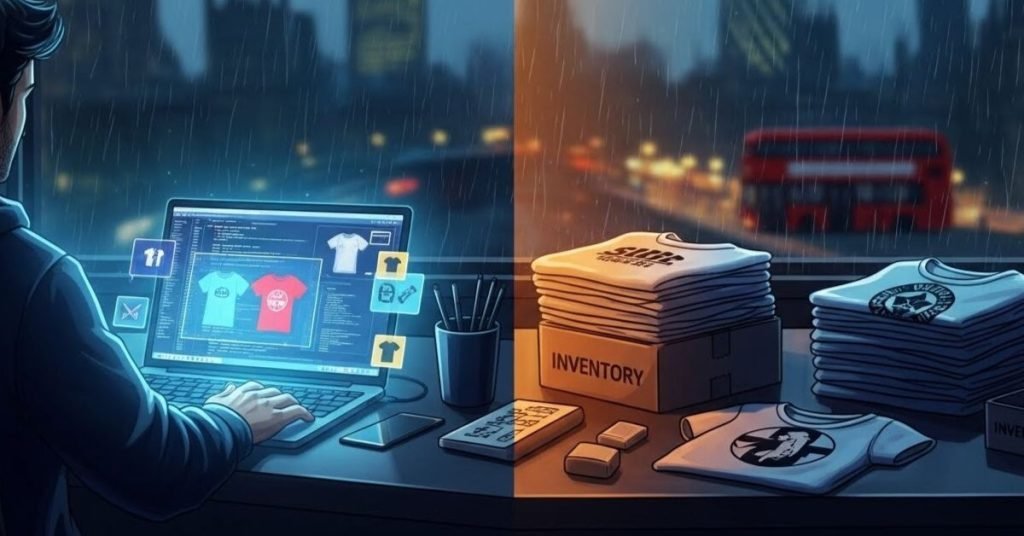
Picture yourself staring at your screen on a rainy Thursday evening, half-drained mug of coffee next to you, tabs full of T-shirt suppliers open like a chaotic constellation. You’ve been toying with the idea of launching some merch — maybe for your dev blog, maybe for your small creator brand — but the moment you start researching printing options, you fall into a labyrinth of unfamiliar terms, hidden fees, and manufacturing jargon. It’s not dramatic, but it is disruptive. One minute you’re casually imagining a cool design on a shirt, the next you realise you have no idea how to bring it into the real world without wasting money, time, or sanity.
That’s the conflict: you know you want to make something, but suddenly it’s clear you don’t yet know how to make the right decisions. And as a developer or small creator in the UK, you don’t get infinite room to experiment. You can’t afford fifty bad prints or three months of shipping delays. You can’t sink cash into inventory that sits in a box under your desk. The moment that truth hits you — that this project isn’t as simple as “pick a printer and go” — something fundamental shifts. You’re no longer just daydreaming about merch; you’re being pulled into a problem that demands a smarter approach.
And here’s where you feel the tension: you want to move fast, but you don’t want to waste money. Quality matters, yet the real challenge is knowing when it’s worth paying for. That tug-of-war is the inciting incident of this whole journey. It pushes you to look deeper, question assumptions, and figure out which printing strategy actually fits your goals — not some generic “best practice,” but something that aligns with your constraints as a developer-creator.
This article marks the moment when everything comes to a halt and becomes clear. You’re going to learn the real trade-offs behind every printing strategy available in the UK — from zero-inventory POD to short-run bulk, premium DTG, sustainable options, hybrid fulfilment, local print partnerships, and even pre-order campaigns. Instead of feeling lost in the noise, you’ll be able to evaluate each path clearly and rationally.
By the end, you’ll know exactly how to launch a T-shirt line without risking excessive time or money—plus, you’ll step beyond the anxiety of making costly mistakes. You’ll transform confusion into clarity and start building with purpose.
Hybrid Fulfillment: Combining Stock and On-Demand Models

Have you already reached a point in your merch journey where the old binary choices start to feel too small for the ambitions you’re carrying? Or pure POD feels safe but limiting? Maybe pure bulk feels empowering, but risky? It’s like trying to run your creator brand on a single gear when the terrain keeps changing beneath your feet. That’s where hybrid fulfilment enters the picture — not as a clever trick, but as the first model that actually matches the way small UK creator brands grow in the real world. It permits you to move fast without taking a gamble, and to think like someone building something that lasts, rather than someone hoping their next design magically takes off. In other words, it lets you evolve instead of choosing a lane too early.
Hybrid works because it meets you exactly where you are today, and where you’ll be six months from now, without forcing a reinvention every time your brand shifts. In the beginning, you operate purely on POD — no stock, no storage, no fear that a box of T-shirts will outlive your momentum. As orders trickle in, patterns emerge: one design repeats, one colour sells more than expected, one idea gets DMs asking when it’s coming back. That’s when the gears shift. You bulk print only the proven winners, reducing your cost per unit while keeping POD active for all experimental items. The result is a system that gives you margin where you’ve earned it and flexibility where you still need it. No other model offers both at once.
The benefits stack up quickly. You eliminate dead stock entirely because nothing goes into bulk until it has real data behind it. You move faster than brands running on traditional supply chains because POD lets you launch new ideas at the hour inspiration strikes. Customers trust you more because the popular designs ship quickly from your own inventory, and the experimental ones ship reliably from your POD provider. Most importantly, hybrid creates a clean pathway for growth that doesn’t rely on luck — beginners start POD-only, growth-stage creators scale their bestsellers through small bulk runs, and advanced creators build full collections while still testing fresh ideas in the background. It mirrors the developer mindset perfectly: iterate → validate → scale.
However, it is the practicality that makes the hybrid prove its worth. You begin with a POD setup using a UK provider such as Inkthreadable, Printful UK, or TwoFifteen. You track your data for 30–60 days — not vibes, not assumptions, but actual order patterns. Sizes that repeat reveal stable demand. Colours that cluster expose audience bias. Designs that keep being shared, even without high conversion, signal cultural resonance. When something consistently performs, you bulk print a micro-run of 20–100 units with a local UK printer to raise your margins. You keep POD enabled for all new ideas so you never stagnate. And if you’re using Shopify or WooCommerce, you automate fulfilment logic so that repeat sellers come from your stock while experimental designs route to POD. You look like a brand with a warehouse — even if the “warehouse” is a neatly stacked box next to your desk.
This model adapts to every audience level. Beginners protect cash flow by sticking to POD-only and limiting themselves to one to three designs. Growth-stage creators shift to a hybrid approach, where a design sells 10–20 times, and bulk printing is reserved for the most predictable winners. Monetisers build out a core collection, bulk for consistency, POD for creativity, and automate everything to keep operations tight. Across all three, the principles remain the same: don’t bulk print based on intuition, keep your colour palette tight, listen to the DMs that ask for restocks, keep a small studio box of inventory for quality checks, and split-test designs through POD before committing. It’s not glamorous, but it’s the stuff that separates people “selling shirts” from people running a brand.
If you’re looking for a push, here it is: you already know how to do this. Iterating features comes naturally. Debugging issues is second nature. Deploying updates is part of your daily rhythm. Hybrid fulfilment is the same process applied to garments instead of code. And the only way to understand how well it fits your workflow is to start small. Launch one POD design this week just to learn the mechanics. Watch what gets clicks or saves, even if nobody has bought it yet. After a month, bulk print a micro-batch of your true best seller — ten units, not a hundred. Test a seasonal design purely through POD. Compare your margins in a simple spreadsheet. These micro-experiments cost almost nothing, but they’ll teach you more in thirty days than months of researching ever will.
This is the model that grows with you. Low risk when you’re new. High leverage when you’re established. Flexibility everywhere in between. And once you see how naturally it supports the way developer-creators build things — incrementally, intelligently, always learning — it becomes obvious why hybrid fulfilment isn’t just an option on a list. It’s the backbone of a sustainable creator brand.
API-Driven Print-on-Demand: The Zero-Inventory Lab for Developer-Creators

At some point — usually when your brain is too tired to overthink — you realise that what’s been holding you back isn’t the merch idea itself. It’s the belief that launching anything physical demands money you don’t have, expertise you haven’t yet earned, or logistics you’re not equipped for. And then, as you stare at your screen surrounded by half-developed design ideas and abandoned supplier tabs, a different thought creeps in: What if I didn’t need to own anything to start? What if I could ship something real without becoming a warehouse manager overnight? That quiet, almost accidental question is the doorway into API-driven print-on-demand.
This model is deceptively simple: you create a design, publish it, and printing only occurs when someone actually purchases it. But for developer-creators, it becomes something far more powerful. It’s the first printing strategy that behaves the way your mind already works. You think in terms of pipelines, iterations, quick deploys, and measurable outcomes. POD with an API lets you treat merchandise like code — making small changes, conducting rapid tests, and zero-risk releases. Instead of wrestling with stock, you’re building tiny, automated experiments that reveal whether your audience wants what you’ve made. It becomes a sandbox with real stakes: every click, every purchase, every return is data that guides your next move.
Once you recognise that, the benefits become obvious. Inventory is no longer a gamble. Bulk orders aren’t a guessing game of sizes or colours. Admin and packaging no longer consume your living room floor. You start with nothing but an idea and a few files — and within a day, you can see real behaviour: which designs people hesitate on, which ones get shared, which ones quietly convert without fanfare. It’s fast learning without financial pain. A safe, controlled testing ground that lets you be bold without being reckless.
And the practicality is far less complicated than creators imagine. You pick a UK-friendly POD provider that exposes a simple API — nothing enterprise-level, just enough to upload artwork, generate product variants, and publish them to your site or store. You wire a tiny script or mini-app that connects those dots. Then you create a few designs, put them live in a tucked-away section of your site, and drive a small amount of real traffic: your newsletter, your Discord, your followers who already care. Within days, you’re looking at signals that actually mean something. Not opinions. Not assumptions. Evidence. If a design repeats, you know it’s worth exploring further. If it dies quietly, you’ve lost nothing except a few minutes of setup — and gained clarity that many creators never achieve.
What makes API-driven POD feel different from the other options is how precisely it adapts to where you are in your creator journey. If you’re at the beginner stage, it protects you from unnecessary risk — you’re launching gently, cheaply, with nothing to lose. If you’re at the growth stage, it becomes your rapid-fire experimentation layer: every new idea goes through POD first, and only the proven ones earn the right to become short-run or hybrid pieces. And if you’re already operating like a monetiser, POD becomes your constant R&D engine, a quiet background system feeding you patterns, insights, and future winners. It’s not your main production method forever — but it’s the method that keeps you honest, curious, and adaptable.
Eventually, you’ll hit the moment where data starts guiding your decisions instead of your fears. Maybe one design gets three organic orders in a week. Perhaps one gets zero but earns a bunch of clicks. Maybe one converts better than expected but gets hit with returns due to sizing quirks. These tiny signals shape your next steps the same way user feedback shapes your code. You learn what to keep, what to fix, and what to abandon. And this process isn’t glamorous, but it’s the process that separates creators who “try merch once” from creators who build something that stays.
If you need a push, here it is: the first step in this model is embarrassingly small. Publish one design. Show it to fifty real people. Watch how they behave. That’s the whole thing. You don’t have to commit to a full store or produce ten ideas at once. You’re just running an experiment — one tiny test that costs less than a mediocre coffee and reveals more about your audience than months of theorising ever will. Once you run that first test, the path ahead becomes clearer. A design that performs consistently will warrant a short run. Some ideas will justify a pre-order. Others will signal it’s time to graduate to hybrid or bulk. And the clarity comes from data — not from guesswork.
API-driven POD isn’t a forever strategy. It’s a launchpad. A proving ground. A pressure-free environment where you can create honestly and learn quickly. And for developer-creators, that’s not just convenient — it’s the exact environment where you do your best work. When you see merch as an ongoing experiment rather than a high-stakes commitment, the fear dissolves. What’s left is clarity, curiosity, and the simple momentum that comes from shipping something real into the world.
Crowdfunded or Pre-Order Bulk Runs: Turning Interest Into Certainty

Eventually, there’s a moment in every creator’s merch journey where you finally admit something you’ve been quietly avoiding: you don’t actually know if anyone wants your design yet. Not really. You can feel momentum on social media, garner a few dozen likes on a mockup, and convince yourself the idea “seems strong”… but none of that proves demand. And as you sit there on another late-night scroll — coffee cooling, browser full of suppliers, head full of half-formed ideas — the thought hits you with uncomfortable clarity: If I print this right now, I’m gambling. That’s the moment pre-orders walk in and confront you. Not softly — honestly.
What makes pre-orders distinct from all the other strategies is how quickly they replace fantasy with evidence. Suddenly, you’re not guessing how many shirts to print. You’re not risking boxes of dead stock quietly mocking you from under your desk. You’re only producing what people have already paid for. That shifts the entire psychology of launching merch. Now you’re operating with zero financial risk, bulk-level pricing, and a level of simplicity that most creators pretend doesn’t exist because it exposes a hard truth: if a design can’t convince ten people to buy during a pre-order window, the problem isn’t printing — it’s demand. That clarity is uncomfortable, but it’s also liberating. It saves you time, money, and false confidence.
And once you step into the mechanics, you realise how straightforward the process is. You choose a platform that matches your stage — Everpress for hands-off and UK-friendly fulfilment, Kickstarter for bigger creative projects, WooCommerce or Shopify with a pre-order app if you want full control. You open a 7–21 day window, build the simplest possible merchandise page (with good mockups, clear sizing, real shipping dates, and a visible countdown), and you actually promote it. Not the timid, once-a-week mention most creators hide behind — proper promotion: stories, behind-the-scenes shots, “24 hours left” reminders, you wearing the prototype, and updates that make your audience feel like they’re part of something unfolding. When the window closes, you print the exact quantities ordered, fulfil them, and communicate until every package is delivered. Linear. Predictable. No chaos.
The beauty of this model lies in its ability to adapt perfectly. It adapts to different creator stages without ever letting you hide behind excuses. Beginners get structure — one design, one platform, no customisation, no pointless perfectionism. Their job is simple: test demand, learn honestly, and avoid waste. Growth-stage creators step into a more strategic rhythm: WooCommerce setups, seasonal drops, upsells like stickers or wallpapers, and smarter timing. Monetisers turn pre-orders into a full-blown revenue engine — limited editions, collaborations, premium blanks, targeted ads — because they finally have the confidence that comes from data, rather than daydreams. Across every stage, the best practices remain the same: prototypes sell better than descriptions, too many options kill momentum, realistic timelines build trust, and consistent communication prevents disasters.
But here’s the part most creators need to hear — the consequence they keep dodging. If you skip pre-orders, you will waste money. You will print too much, too early, and end up discouraged before you’ve even learned anything. The real cost isn’t the cash you burn; it’s the lost momentum and the belief that “merch just isn’t for me.” Pre-orders protect you from that spiral. They expose the truth early, when the stakes are tiny and recoverable, not after a £300 print run you’re too embarrassed to talk about. And the best part? You don’t need a massive audience to run one. A single 24-hour micro-drop, an A/B test between two mockups, a simple poll on colourways — these tiny experiments reveal more about your audience than months of overthinking ever will.
If you need a push, here it is: run a small pre-order this month. One design. One window. One clear deadline. Show it to real people — not hypothetical fans, not the algorithm, actual humans who follow you because they care about your work. Watch what they do, not what they say. Because once you see data coming in — orders, clicks, hesitations, shares — you’ll finally stop treating merch like a puzzle and start treating it like what it really is: a system you can learn, refine, and scale. Pre-orders don’t just protect you from mistakes; they give you momentum grounded in reality. And momentum, not perfection, is what grows a real creator brand.
This is the strategy that cuts through noise, uncertainty, and wishful thinking. It’s merch built on truth. And once you feel how clean, calm, and controlled that process is, you’ll wonder why you ever tried to operate in the dark.
Short-Run Bulk Printing: The Moment Your Idea Has to Prove Itself

There comes a day when you stop scrolling through POD options and start wondering what it would feel like to hold your design in your hands. Not a mockup. Not a digital render. A real shirt. That’s when short-run bulk printing shows up. Not as the “cheapest option,” not as the “pro’s choice,” but as the moment where your design stops being hypothetical and starts being accountable. It forces a question most creator-developers avoid for as long as possible: Does anyone want this enough to buy it? And you feel that question land in your chest because you know it’s the one that actually matters.
What makes short-run bulk feel different from every other model is how quickly it strips away wishful thinking. POD keeps you comfortable. Eco-options let you feel confident in your principles. Pre-orders allow you to delay commitment. But bulk? Even a tiny run of 20–30 shirts demands clarity. It turns ideas into inventory. It turns opinions into outcomes. And the moment that box arrives — the moment you open it and see your work as something physical — you realise how much of your decision-making up to this point has been theory. Bulk forces you into reality. It’s uncomfortable, but it’s also the cleanest signal you’ll ever get about whether your work resonates beyond the screen.
And once you step into it, the benefits become far sharper than the risks. Better margins unlock immediately — far beyond what POD can offer. Consistent quality follows because you picked the printer, approved the sample, and chose the blanks yourself. Colour accuracy and fabric feel stop being a question once you’ve held them in your hands. You also learn faster. When you’re sitting on a micro-stack of shirts in M, L, and XL, you discover things no mockup ever taught you: which sizes actually move, which colourways feel better in person than online, which designs people gravitate toward when they see them worn instead of rendered. The feedback loop speeds up, and so does your growth.
The practicality is far simpler than creators pretend. You start with validation — a poll, a DM check, a newsletter click, anything that tells you people care. Then you sample. No serious creator skips this step. You pick a UK printer with low MOQs, order a single prototype, and stress-test it: wash, wear, stretch, photograph. When it passes, you commit to a micro-batch of 20–50 units. Keep the sizing spread narrow (UK markets skew toward M and L far more than beginners expect). Launch with honesty — “small run, limited units” — nothing fake, nothing manipulative. Then fulfil fast to build trust. This isn’t about hype; it’s about proving you can deliver.
Different stages of creator-brand growth use this model in different ways. Beginners treat bulk as a truth-teller — if they can’t move 15 shirts, the design isn’t ready, and that’s a lesson worth learning early. Growth-stage creators intentionally run micro-drops, using each one to learn about repeat themes, colour preferences, or which inside jokes actually travel. Monetisers operate bulk as a rhythm — seasonal batches, recurring bestsellers, community-led themes — because they already know what works and want tighter margins and more control. Across all three groups, the core principle stays the same: bulk printing is where seriousness begins.
If there’s one push you need, it’s this: stop waiting for certainty before you try something that will give you certainty. Bulk printing tests your idea the same way shipping code tests your assumptions. Make a small batch — ten, twenty, maybe thirty units. Nothing life-ruining. Nothing reckless. Put it in front of real people. Pay attention to what sells first and what hesitates. Look at the data without ego. You’ll learn more from one micro-run than from months of reading guides, watching YouTube breakdowns, or fantasizing about a “perfect” launch.
Short-run bulk printing isn’t glamorous, and it isn’t easy. However, it’s the first model that transforms you from someone imagining merch into someone running a merch operation. The moment those shirts arrive, everything sharpens: your decisions, your expectations, your understanding of your audience, and your ability to execute. That’s why this option matters. It forces your idea to stand on its own legs — and that’s exactly where real creator brands begin.
Local UK Print Partnerships: Getting Real with Your Merch

Imagine this: it’s a quiet Tuesday afternoon, and instead of staring at endless supplier tabs or dreaming about automated dropshipping, you’re standing inside a local print studio. There’s a faint smell of fresh ink, racks of tees drying under warm lamps, and a printer with a small run finishing up your sample order. You hold the shirt in your hands, feeling the weight of the real fabric and inspecting the sharpness of the print as well as the texture of the ink. This moment isn’t just tactile—it’s transformative. It’s where your ideas stop floating in digital space and start demanding accountability.
For UK developers and small creators, local print partnerships aren’t just another option — they’re a mirror reflecting how serious you really are about building a brand. Unlike API-driven POD, which hands off ownership to faceless systems, or eco-friendly on-demand services that inflate costs and complicate logistics, local studios bring you face-to-face with the realities of quality, timing, and customer expectations. They don’t just print shirts—they print your credibility. The trade-off? It’s less convenient, yes. But with that comes clarity: real conversations, real feedback, and real control over every step from file to finished product.
Practically speaking, getting started is less daunting than it feels. Begin by hunting for local printers—try searches like “DTG printer London UK” or “short run T-shirt printing Manchester.” Look for transparency: studios with galleries that show finished work, clear pricing, and upfront production timelines. Then, put your money where your mouth is—order paid samples rather than chasing freebies. Get a DTG shirt on light fabric, one on dark fabric, and if relevant, a screen print sample as well.
Treat the inspection like a code review—no shortcuts. Check print quality, colour accuracy, durability, and the feel of the fabric. If it’s not up to standard, your customers will notice. After that, test the waters with micro-runs of 10–20 units to gauge whether your audience actually cares, to refine your logistics, and to test your pricing discipline without betting the farm. Build trust by communicating clearly: send clean artwork, respect printer templates, and avoid flip-flopping on instructions. Printers prioritise creators who respect their craft and time.
This approach isn’t one-size-fits-all. Beginners should treat local printing as an education system—stick to DTG, keep it small, and use each micro-run to learn about sizing, print placement, and customer expectations. Growth-stage creators can leverage local partnerships to increase predictability by running drops of 20–50 units, tracking what sells, and start crafting a consistent look. Monetisers? This is your infrastructure. Lock in suppliers, negotiate margins, standardize blanks, and maintain a steady stock flowing alongside POD for fringe items. Across all stages, never skimp on blank quality—a cheap shirt undermines everything. Document your processes meticulously, batch orders to minimize inefficiencies, and if possible, visit your printer in person. These aren’t niceties—they’re essentials that turn good brands into great ones.
If you want to stop guessing and start building, here’s the push: order a sample from a UK printer in the next 48 hours. Don’t overthink. Feel the garment, see the print, and confront the realities your screen can’t show you. Experiment with blank types, compare DTG and screen print, try 10 units versus 30, or run a small local-exclusive drop. Treat every step like debugging—test, observe, adapt. This is how developer-creators grow into real creators. Not by hiding behind convenient tech, but by wrestling with the messy, human side of making things that last.
On-Demand Eco-Friendly Printing: The Sustainable Path That Doesn’t Let You Hide Behind Excuses

A specific kind of guilt that creeps in when you’re thinking about launching merch as a UK creator. You want to make something meaningful… but you also know the planet doesn’t need another pile of unsold cotton rotting in a storage unit. And as you sit there staring at your screen — tabs full of blank suppliers, sustainability claims, and contradictory advice — you feel the tension between wanting to build your creator brand and not wanting to contribute to yet another avoidable mess. That internal conflict is exactly where on-demand eco-friendly printing steps in: not as a moral high ground, but as a brutally practical solution that forces you to make smarter decisions.
This model isn’t about “feeling good.” It’s about eliminating the waste that usually comes from impulse, ego, or untested ideas. You don’t print anything until someone buys it. Dead stock disappears. Unsellable sizes stop piling up. Wishful thinking no longer masquerades as “inventory.” For developer-creators, that’s not just sustainable — it’s efficient. It aligns with the way you already build things: small, iterative, low-risk, and data-driven. Eco-friendly POD isn’t a trend; it’s a corrective measure for creators who want to launch merch without unintentionally becoming part of the problem.
Money no longer disappears on shirts nobody asked for. The environmental footprint shrinks to almost nothing because production happens only when demand is confirmed. Access opens to organic cotton, water-based inks, certified factories, and UK-based suppliers that actually meet sustainability standards instead of pretending to. Responsible purchasing becomes effortless for your audience, without hoops or compromises in quality. The outcome? A cleaner conscience and a cleaner balance sheet — a rare combination most creators don’t realise is possible.
The practical setup is embarrassingly straightforward. The first step is choosing a UK‑friendly sustainable POD provider — places like Teemill, Inkthreadable’s eco‑line, or AOP’s organic catalogue. From there, a small set of designs is enough — not ten, not twenty, but one to three. Colourways stay tight, since sustainable blanks often offer fewer options but higher quality. A simple product page follows, with real information: what the shirt is made of, why it’s printed on demand, and how emissions are minimised. Then you launch. Overplanning disappears. Stockpiling becomes irrelevant. Pretending you need a full collection is no longer necessary. Fulfilment happens automatically. Waste stays at zero.
Different stages of your creator journey benefit you in different ways — and this is where most people lie to themselves. Beginners get no excuses; eco-POD forces them to focus on the design, the story, and the message instead of overproducing out of insecurity. Growth-stage creators get to test their brand values properly, proving they can run drops without cutting corners. Monetisers get to build a sustainability layer into their brand narrative without compromising on margin, because once a design proves itself, they can shift the proven winners into hybrid or bulk while keeping eco-POD as their evergreen “always available” option.
And here’s the part most creators avoid saying out loud: if you claim to care about sustainability but still bulk print untested designs, you’re not being principled — you’re being reckless. Eco-friendly POD removes that hypocrisy. It provides a system where the environmentally responsible choice is also the least wasteful and least risky business choice. It stops you from hiding behind “one day I’ll do this properly” and forces you to start with what’s real, measurable, and responsible.
If you need a push, consider launching one eco‑POD design this week. One. Make it intentional. Make it clean. Tell your audience you’re printing only what gets ordered — no waste, no leftovers, no landfill. Watch who buys. Notice who asks questions. Pay attention to who shares. This tiny move will teach you more about your audience’s values, your own messaging, and the actual demand for your ideas than any hundred‑hour research session ever will.
Eco-friendly POD isn’t the “green option.” It’s the disciplined option. It’s the model that keeps you honest, focused, and aligned with what you say matters. And once you see how naturally it fits into the way you already build and ship things as a developer, it becomes obvious why this approach deserves a place in your creator toolkit. It’s low risk, high integrity, and brutally effective — exactly what most creators need, but rarely commit to.
Premium Direct-to-Garment Printing for High-Quality Apparel

Picture yourself hunched over your laptop on another soggy day, a half-empty mug cooling beside you, mockups scattered across tabs like unread TODOs. You’ve been flirting with the idea of “proper” merch — something that actually looks like it belongs in a shop, not a giveaway at a conference — but every route you find either demands a warehouse, forces compromises on the design, or feels like a slow, expensive experiment. Premium DTG is the moment you stop treating merch like a hobby and start treating it like product design. It doesn’t let you hide behind “cheap merch” excuses; it forces clarity. Either your idea is worth £30–£40 on the street, or it isn’t. DTG is merciless — and that’s its value.
The upside is immediate and concrete: DTG gives you full creative freedom (photorealism, gradients, tiny details), removes inventory pressure because you can test without bulk, and functions as a rapid price-elasticity check — you learn what your audience will actually pay for. Practically, this looks simple but non-negotiable: pick a DTG provider that maintains its pretreat and machines (cheap, rushed shops are the fastest route to washed-out prints); prepare artwork at 300 DPI with attention to colour management; order one sample and subject it to real-world abuse (wash 5×, stretch, wear) so you can vet both blank and print; price with confidence — £28–£40 for the right blank and story — and launch the drop with intention, not desperation. The only real resources you need are £40–£60 for a proper sample and the discipline to treat the test as data, not decoration.
Different creators will use DTG for different wins. Beginners: Stop planning collections — print one strong design, hold the sample, and see if a single person makes a purchase. Your milestone is a purchase, not applause. Growth-stage creators: use DTG to validate premium ideas and limited editions, then move proven designs into short-run bulk or hybrid fulfilment to raise margins. Monetisers: don’t make DTG your primary volume channel — use it for exclusives, collabs, and upsells where the story justifies the price. Best practices across the board: choose quality blanks (AS Colour, Stanley/Stella), design for DTG’s strengths (depth, colour, fine detail), test dark garments to vet pretreat, and always sample — skipping the sample is how you earn refunds and bad reviews. Sell the story and craft, not the printing method; customers pay for perceived value, not manufacturing notes.
If you want momentum instead of theory, run this tiny experiment: pick your strongest design, order one premium DTG sample today, photograph it honestly (no filters), post it as a pre-order with a short window, and measure behaviour — who buys, who bookmarks, who asks sizing questions. Treat each order as a data point; adjust price, copy, or placement based on real purchases, not likes. DTG is a lab, not a business plan: use it to test whether your product ideas are worthy of scaling. If you can’t bring yourself to order the sample, that hesitation is useful information too — it means you’re not ready to face the truth about the work, and delaying will cost more than £60 in wasted opportunity. Order the shirt. Learn the lesson. Then decide what to do next.
At the end of the day…
You’re back at your desk. The same mug, the same tabs — but something has shifted. The confusion that pulled you into this journey is still there, but it’s no longer a wall you run into; it’s a fork in the road you understand. This is the Choice moment. You can continue to circle the same questions you had on that rainy day, or you can take what you now know and commit to a direction. Not the “perfect” direction, not the one some guru swears is the only right way — but the path that actually fits your goals, your constraints, your creator identity. And that decision matters. It’s the moment where you stop being someone who wants to make merch and become someone who is making it, deliberately and intelligently.
And once you make that call, the Consequence becomes your new normal. You stop hesitating every time someone mentions POD or DTG. You stop wondering whether you’re about to waste money. Instead, you’re running small experiments, releasing designs that feel true to you, learning from real data, and watching your creator brand expand into something tangible — something people can wear, gift, talk about, and remember you by. The chaos becomes a system. The uncertainty becomes momentum. The merch idea that once felt fragile becomes a real part of your creative ecosystem.
So here’s your next step: keep that momentum alive. Subscribe to Digital Creator World so you don’t lose your edge — every week we break down practical, hype-free guidance that helps developer-creators think sharper, build faster, and create work they’re proud of. And if you’re ready to take your first small leap into physical products, explore the creator gear and tools we’ve built for people just like you. Think of them as companions on the road you’ve chosen — helpful little boosts as you turn clarity into action and action into something real.